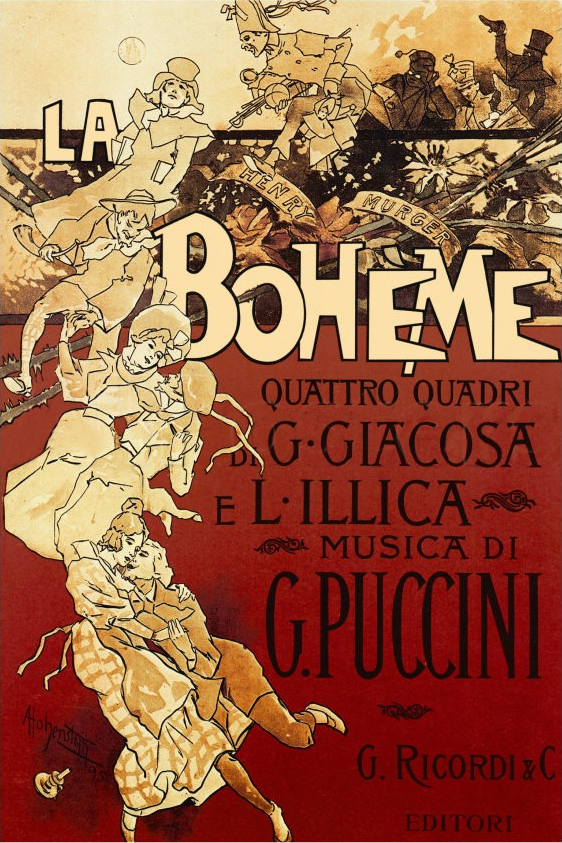
Giacomo Puccini: La Bohème – best recordings
La Bohème is a great entry point into Italian opera. Verismo, the dominant style of Italian opera at the time, aimed to bring opera closer to ordinary people than traditional grand operas did. Here, we follow the story of ordinary young people, capturing the joys and heartbreaks of real life. What a contrast to Don Carlo, with its sweeping conflicts between a king, the Catholic Church, politics, and war. Puccini created a masterpiece that seamlessly balances sadness and joy, filled with deeply emotional, direct music.
Hier sind zwei verbesserte Varianten, bei denen auch der unvollständige Satz am Ende sinnvoll ergänzt wurde:
The story itself is quite simple: four young artists living penniless in Paris, making the best of life. Act I introduces them in their freezing apartment, playfully amusing themselves and tricking their landlord, Benoît, when he comes to collect the rent. Toward the end of the act, Rodolfo meets Mimì and they instantly fall in love—brought to life by Rodolfo’s aria ‘Che gelida manina’, Mimì’s ‘Sì, mi chiamano Mimì’, and their beautiful love duet. In Act II, we join the group at Café Momus, where Musetta, Marcello’s ex-lover, provokes her wealthy admirer Alcindoro before returning to Marcello and leaving the bill for Alcindoro to pay. In Act III, the tone grows more melancholy—typically Puccinian—as Mimì’s illness becomes a grave concern, even as a touch of warmth lingers at the end. Act IV begins with a return to that initial lightheartedness, before ending dramatically with Mimì’s tragic death.
When it comes to the roles, the pair of Mimì and Rodolfo is central. The singers need lyric voices capable of capturing both the opera’s lighthearted moments and its deep tragedy. In my view, Puccini’s score supports the singers brilliantly, perfectly supporting the dramatic intent. Historically, benchmark interpreters for Rodolfo include Pavarotti, Björling, and Gedda, with Victoria de los Ángeles as a typical Mimì. While the other roles are important, they are less exposed. Finally, as is so often the case, the conductor plays a crucial role—balancing the story’s initial insouciance with the overwhelming Puccinian emotion and sadness of the finale.
So, which recording would I recommend? In my view, the choice is actually quite straightforward: Beecham with Victoria de los Ángeles and Jussi Björling for a historic classic, and Karajan with Mirella Freni and Luciano Pavarotti for a more modern option. Tullio Serafin with Renata Tebaldi and Carlo Bergonzi sits nicely somewhere in between. I know I’m not being very original here, but to be honest, having listened to a lot of recordings, very few are truly bad.
| Recording | Artists | What I like | What I don’t like | So/So | Quality |
|---|---|---|---|---|---|
| sir Thomas Beecham (1956) | Mimi: Victoria de los Angeles Rodolfo: Jussi Björling Marcello: Robert Merrill | The vivid conducting of Beecham The great singing | It’s not always perfect, in someway nee | ***** (mono) |