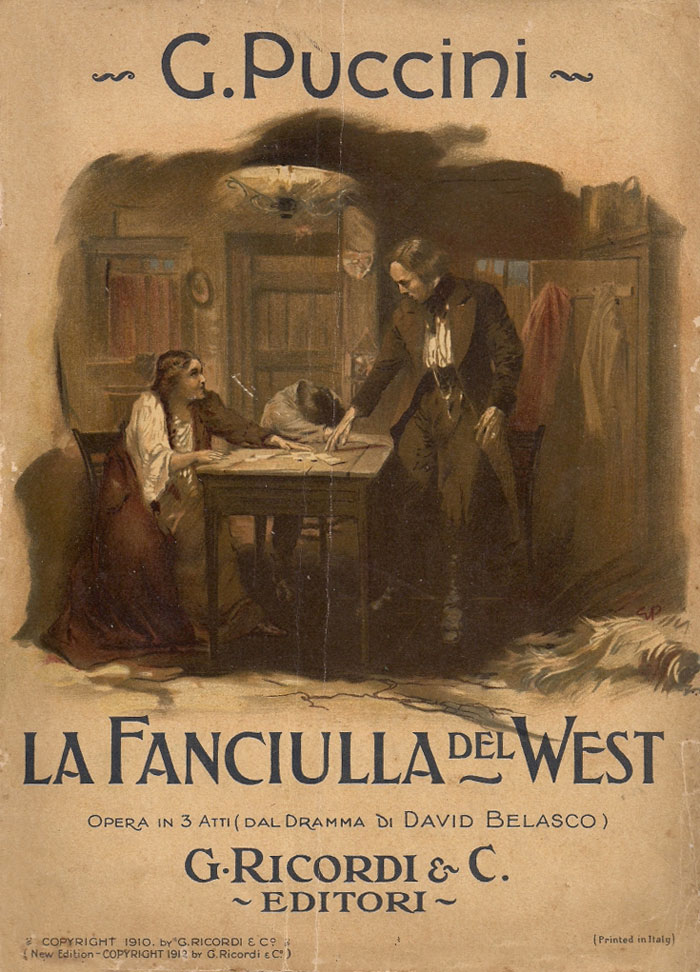
Giacomo Puccini: La fanciulla del West – Franco Capuana (1958)
La fanciulla del West remains one of Puccini’s less frequently performed operas. While its 1910 premiere at the Metropolitan Opera was actually a massive triumph, the work struggled to maintain its popularity, likely because traditional audiences failed to connect with its Wild West subject matter.
Historically, it seems audiences—despite the high-profile Met premiere—ultimately struggled to connect with the plot. Personally, I view La fanciulla as a crucial evolution in Puccini’s style, one that culminates in Turandot. It retains the signature melodic flow of La Bohème, but the orchestral color belongs definitively to the 20th century. It is perhaps a more intellectual work than his previous operas, even though the story itself has a very raw, immediate appeal.
Ultimately, it is one of my favorite Puccini operas. It features some of his most interesting orchestration—far more sophisticated than La Bohème, for instance—even though the characters themselves are very ordinary, grounded people.
For me, the definitive version of this opera is undoubtedly the Capuana recording. As an early stereo release, the sound isn’t flawless, but ultimately, the audio quality holds up remarkably well.
Conductor Franco Capuana may not be a star, but he thoroughly knows his craft. While his direction lacks a bit of the refinement needed to fully bring out the score’s orchestral richness, it is undeniably well-executed. The Orchestra e Coro dell’Accademia di Santa Cecilia perform with a similar level of dependable craftsmanship.
The true highlight of this recording is undoubtedly the pairing of Minnie and Johnson, with Renata Tebaldi making for a gorgeous Minnie throughout. While she occasionally lacks a bit of subtlety, her performance is beautifully sung. The most fascinating singer here, however, is Mario del Monaco. Although he is usually renowned for his sheer vocal power, what strikes me most in this performance is the beauty of his tone, which the recording captures remarkably well. As a result, it remains one of the finest renditions of Dick Johnson available. His portrayal is exactly as virile as you would expect, possessing all the necessary sex appeal the character demands. After all, let’s not forget: Minnie is the only woman in the camp…
Cornell MacNeil also sings the role of Rance exceptionally well. His voice is intrinsically beautiful, which works perfectly for the character. In my view, Rance is a highly complex role. It’s important to understand that he isn’t a traditional villain—if anyone fits that description, it would be Johnson. Ultimately, Rance is simply a man driven by intense jealousy at the end.
The rest of the cast is equally strong. This is crucial, as the opera features numerous interesting supporting roles that vividly bring the world of the story to life.
Interested in this recording? Get it on Amazon here (affiliate link).