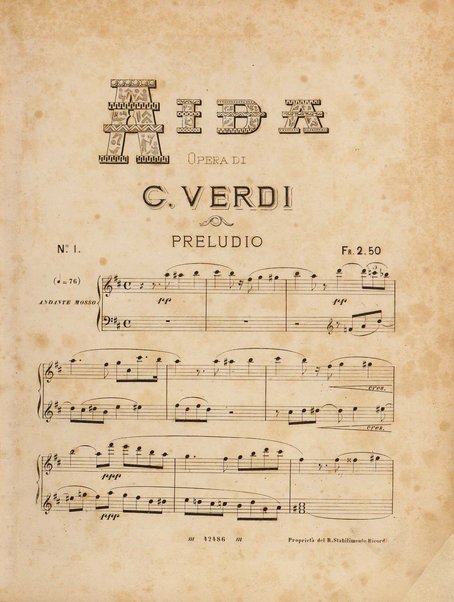
Giuseppe Verdi: Aida – best recordings
Aida was the first opera I consciously listened to as a teenager. I first saw it in a massive public performance at the Palais Omnisports in Paris-Bercy (similar to a stadium production). I was so overwhelmed by this experience that I started listening to more and more opera recordings. Naturally, I began with a recording of Aida (the one conducted by Muti), which was given to me by my great-aunt and great-uncle. I listened to it over and over again…
Verdi wrote Aida as a commission from the Khedive of Egypt for the opening of the Suez Canal, in a deliberately Egyptian style. It is probably also deliberately showy (think of the famous trumpet scene), even though the plot—and thus the whole opera—is much more intimate than you might expect. The story centers on a love triangle between Aida, Amneris, and Radamès, intertwined with patriotic and familial duties for Aida, military ambitions for Radamès, and political power for Amneris. In some ways, it is a bit like Don Carlo, but with a stronger emphasis on the love aspect. It really is a great piece, consistent from the beginning to the very last note, showing Verdi’s total mastery at this stage of his career.
As already mentioned, Aida is a very cohesive piece, even though it retains a traditional structure with arias, ballets, and so on. Radamès’s aria (“Celeste Aida”) at the beginning of the opera is difficult for the tenor, since it comes so early, but I don’t find it to be the most interesting aria. The real highlight for me is Aida’s aria (“Ritorna vincitor!”). It is much more fascinating, showing Aida’s conflict between her family, her country, and her love for Radamès. Furthermore, the third act as a whole is the cornerstone of the opera, where everything takes a dramatic turn. Starting with the atmospheric sounds of the Nile, it’s like a great one-act opera in itself. A final highlight is the last duet (“O terra, addio”) between Aida and Radamès, which is, in my opinion, one of the greatest love duets in all of opera. With the right singers, it can easily bring you to tears. The trumpet scene is of course nice and very well known, but for me, it is primarily just an impressive spectacle.
So, which recording? For me, the Solti recording has the right mixture of energy, beauty, and consistency, paired with fine orchestral playing, and good sound. Furthermore, the recording features the right singers for the roles. Price and Vickers are truly great interpreters of their characters, and the other singers are at least on par with them. If you like it a little more historical, take the Perla with Milanov and Björling…
| Recording | Artists | What I like | What I don’t like | So/So | Quality |
|---|---|---|---|---|---|
| Jonel Perlea (1956) | Aida: Zinka Milanov Radamès: Jussi Björling Amneris: Fedora Barbieri Amonasro: Leonard Warren | Glorious golden age singing (Björling and Milanov with great sound) Perlea conducts in the classical italian spirit | The sound is a little muffled Not everything is perfectly in place | ***** (analogical stereo) | |
| sir Georg Solti (1962) | Aida: Leontyne Price Radamès: Jon Vickers Amneris: Rita Gorr Amonasro: Robert Merrill | Solti, all singers | It’s more on the energetic side Not everything is perfectly in place | ***** (good analogical stereo) | |
| Riccardo Muti (1974) | Aida: Montserrat Caballé Radamès: Plácido Domingo Amneris: Fiorenza Cossotto Amonasro: Piero Cappuccilli | Muti’s well balanced conducting Domingo is a very good Radamès Good verdian singing | Caballé is good, but not superlative here in my view | **** (good analogical stereo) |